Electroless Nickel
An advanced solution that combines precision, protection, and performance for current and future industrial challenges.
Coating technology supporting the new industry
Electroless nickel stands out among surface treatments by providing a uniform and controlled coating layer that simultaneously enhances corrosion resistance, wear resistance, and protection against chemical agents, while maintaining high dimensional accuracy even in parts with complex geometries.
It is also important to highlight the role that electroless nickel plays —and will continue playing— in the challenges that both industry and society are already facing. Its positioning is already highly relevant in the electrification of the automotive industry and in the evolution of sectors linked to hydrogen-based energy, as it provides highly valued solutions, and in some cases, irreplaceable ones.
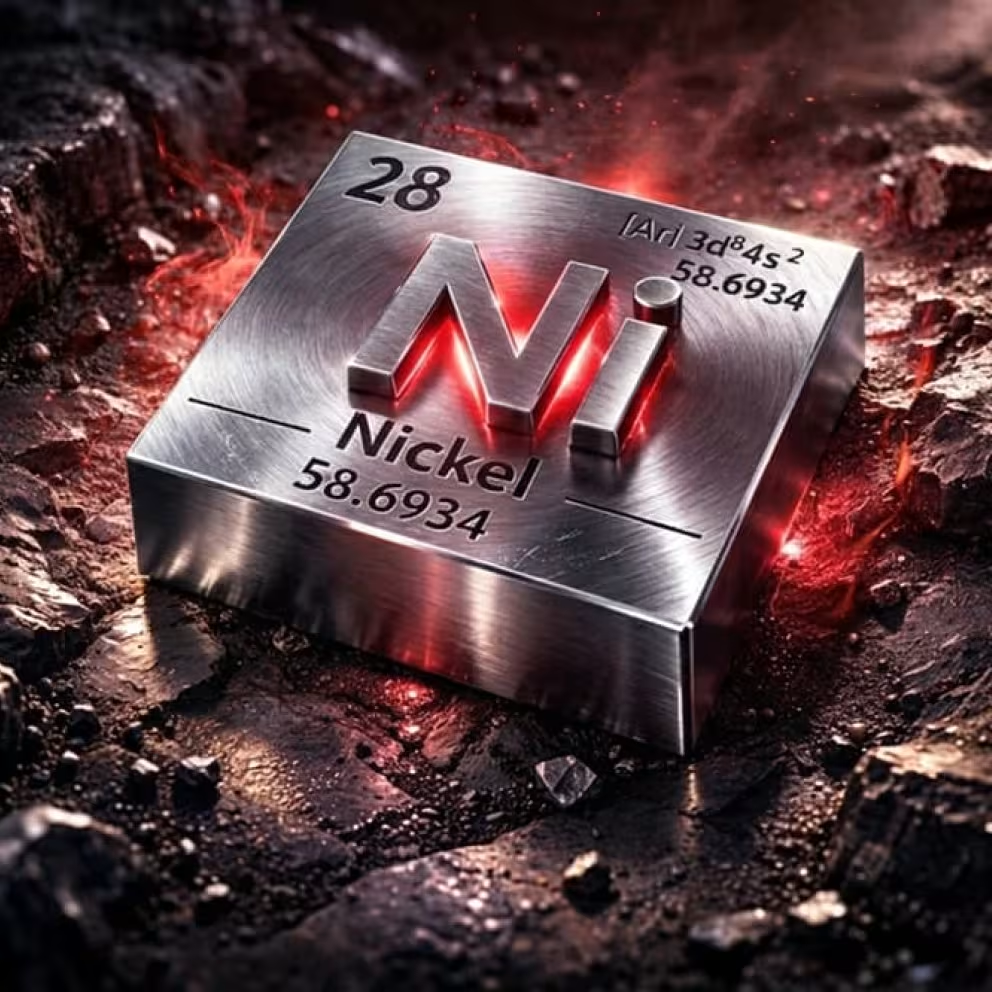
Electroless Nickel Comparison
| Criterion | Electroless Nickel |
|---|---|
Applicable materials | Applicable to carbon steel, stainless steel, aluminum (with pretreatment), copper, brass, and certain special alloys. It can also be applied to some metallizable plastics. |
Thickness uniformity | Autocatalytic deposition without electric current → highly uniform thickness even on complex geometries, cavities, and deep holes. Typical variation: ±5%. |
Dimensional control | Excellent dimensional control due to its uniformity. Ideal for precision parts and tight tolerances. Enables predictable dimensional growth with high repeatability. |
Wear resistance | High hardness (500–600 HV as-deposited; up to 900–1,100 HV after heat treatment). |
Corrosion protection | Very high, especially in high-phosphorus coatings (10–13% P). Amorphous structure without microporosity → excellent performance in aggressive environments and salt spray. |
Chemical resistance | Good resistance to alkaline environments and many chemicals. High phosphorus improves performance against acids. |
Electrical conductivity | Conductive, but lower than electrolytic nickel or copper due to phosphorus content. Higher phosphorus reduces conductivity. |
Thermal stability | Good stability up to approx. 300–400 °C. Heat treatment improves hardness but may reduce corrosion resistance. |
Versatilidad funcional | Buena estabilidad hasta aprox. 300–400 °C. Tratamiento térmico mejora dureza pero puede reducir resistencia a corrosión. |
| Technical aspect | Advantage over electrolytic zinc plating |
|---|---|
Thickness uniformity | Uniform thickness on edges, cavities, and threads; not dependent on the electric field. |
Dimensional control | Better repeatability and tighter tolerances. |
Wear resistance | Hardness of 500–700 HV (>900 HV with heat treatment); significantly higher than zinc. |
Corrosion resistance | High barrier protection without the need for additional passivation. |
Chemical resistance | Excellent resistance to hydrocarbons and solvents. |
High temperature performance | Maintains properties where zinc coatings degrade. |
Coefficient of friction | Can be reduced with Ni-PTFE or high-phosphorus coatings. |
Hydrogen embrittlement | Lower hydrogen intake compared to acidic electrolytic processes. |
| Technical aspect | Advantage over electrolytic zinc-nickel plating |
|---|---|
Thickness uniformity | Uniform thickness on edges, cavities, and threads; not dependent on the electric field. |
Dimensional control | Better repeatability and tighter tolerances. |
Wear resistance | Hardness of 500–700 HV (>900 HV with heat treatment); significantly higher than zinc. |
Corrosion resistance | High barrier protection without the need for additional passivation. |
Chemical resistance | Excellent resistance to hydrocarbons and solvents. |
High temperature performance | Maintains properties where zinc coatings degrade. |
Coefficient of friction | Can be reduced with Ni-PTFE or high-phosphorus coatings. |
Hydrogen embrittlement | Lower hydrogen incorporation compared to acidic electrolytic processes |
| Technical aspect | Advantage of electroless nickel over phosphating |
|---|---|
Coating function | Functional and protective coating by itself. |
Corrosion resistance | Significantly superior without the need for painting or oiling. |
Thickness uniformity | Controlled and uniform thickness even on complex geometries. |
Dimensional control | Suitable for tight tolerances and precision parts. |
Wear resistance | High hardness (500–700 HV; >900 HV with heat treatment). |
Barrier protection | Continuous, non-porous coating. |
Chemical resistance | Excellent resistance to industrial agents and fuels. |
Thermal stability | Maintains properties at elevated temperatures. |
Surface finish | Smooth surface, available in bright or satin finishes. |
| Technical aspect | Advantage of electroless nickel over anodizing |
|---|---|
Applicable materials | Applicable to steels, aluminum, copper, and other alloys. |
Thickness uniformity | Fully uniform thickness across the entire geometry. |
Dimensional control | Excellent control without irregular coating growth. |
Wear resistance | High hardness and improved tribological performance. |
Corrosion protection | Continuous protection even in the presence of minor damage. |
Chemical resistance | Greater resistance to solvents and industrial environments. |
Electrical conductivity | Maintains surface conductivity. |
Thermal stability | Better performance under thermal shock conditions. |
Functional versatility | Properties can be tailored through phosphorus content and heat treatment. |
| Technical aspect | Advantage of electroless nickel over hard chrome plating |
|---|---|
Thickness uniformity | Fully uniform thickness across the entire part, regardless of geometry; hard chrome shows variations due to electric field effects. |
Coating of complex geometries | Excellent coverage in cavities, threads, and blind holes where hard chrome has deposition limitations. |
Dimensional control | Better tolerance control without edge build-up; reduces the need for post-machining. |
Surface finish | Capability to gurantee low Ra without the need for subsequent polishing or grinding. |
Current-free process | Does not require electrical contacts or complex racking. |
Environmental and regulatory impact | Does not use hexavalent chromium (Cr⁶⁺); greater compliance with environmental regulations. |
Microcracking | Continuous, dense coating without inherent microcracks. |
Corrosion resistance | Better performance against general corrosion without additional sealing. |
Adhesion | Very good metallurgical adhesion to the substrate. |
Reproducibility | High stability and repeatability of thickness and properties. |
Functional versatility | Properties can be tailored through phosphorus content and heat treatments. |
Material applicability | Applicable to steels, aluminum, copper, cast irons, and special alloys. |
Overall cost | Can reduce total costs by minimizing rework and post-machining operations. |